

In any Marketing Automation Platform (MAP) or Customer Engagement Platform (CEP) migration, marketing teams spend a lot of time agonizing over assets, workflows, and data points and structures that will migrate into the new platform. Unfortunately, what you can’t migrate is institutional knowledge. Even more unfortunately, most organizations don’t even realize they’ve lost it until six months after go-live on the new platform. The human capital dimension is one of the most underestimated risks in any MAP/CEP migration. When platforms change, the expertise your team has built over years — the muscle memory, the workarounds, the undocumented logic buried in campaign configurations — doesn’t transfer automatically. Without a deliberate reskilling strategy, organizations end up with a shiny, new platform operating at a sophistication level less than the old one, by a team that is simultaneously demoralized and overwhelmed.
It doesn’t have to be this way. As we learned in A Marketing Geek’s Guide to: Marketing Automation Platform (MAP) Migrations, budget and time are allocated in the migration project plan for your team’s skills training. Taking it a step beyond simply a line item for vendor training sessions, we need to understand that talent continuity is a strategic risk that requires proactive management. Platforms like Salesforce Marketing Cloud, Adobe Marketo, and Braze require distinct mental models and vastly different technical competencies. The transition between them is not a minor learning curve. It’s a significant professional shift. So where do we begin?
Conducting a Role-Based Skills Gap Analysis for MAP/CEP Migration
To start, we need to take the time to conduct a meaningful skills gap analysis during our MAP or CEP migration.This requires moving beyond a generic “team training” approach, and mapping competencies specifically by role. Start by defining the core technical and strategic requirements of your destination platform for each functional role. Document what is needed for roles such as platform administrators, campaign managers, email specialists, designers, and marketing analysts. For instance, an administrator transitioning from Marketo to Salesforce Marketing Cloud needs to be assessed not just on their ability to build workflows, but on their specific proficiency with SQL, AmpScript, and data extensions, whereas a campaign manager may need expertise to shift from a “list-based” mental model to a “journey-based” orchestration logic. By isolating these platform-specific technical requirements by role, you can identify where institutional knowledge remains valid and where “unlearning” needs to occur. Truthfully, “unlearning” old habits is as critical to your success in your new platform as learning the new features.
The actual assessment should combine self-reported proficiency levels along with objective, scenario-based testing that mimics daily operations on the new platform. Instead of asking “Do you know how to build an email?” which is a transferable skill, ask role-specific questions like “How would you configure a multi-step nurture program using this platform’s specific logic?” This type of questioning will quickly reveal gaps in your team’s “operational muscle memory”—the undocumented logic that experts rely on to be efficient. Mapping these gaps allows you to customize 90-day reskilling roadmaps that prioritize high-impact functions first, ensuring that your “institutional knowledge carriers” are empowered rather than overwhelmed. This targeted approach prevents your organization from operating a sophisticated new platform with outdated strategic models and helps prevent post-migration process stagnation.
Platform Training vs. Operational Reskilling in MAP/CEP Migrations
Vendor platform training typically focuses on the “mechanics” of the new system. It is designed to teach users how the platform operates, where the buttons are located, how to navigate the menus, and the basic steps to build a campaign or pull a report. While this type of training is absolutely essential for establishing a baseline technical literacy, vendor training is inherently generic. It treats the platform as a blank slate, ignoring the complexities of legacy processes, custom integrations, and the specific business logic that defines your organization’s actual marketing operations.
To be truly successful, you should explore operational reskilling strategies. Operational reskilling is a much deeper, more strategic endeavor that addresses how your specific team will function within the new environment. It involves translating years of institutional knowledge and “muscle memory” from the old platform into the mental model of the new one. Operational reskilling covers the undocumented workarounds, the specific naming conventions, and the unique workflow triggers that your team relies on to work efficiently. Without this type of operational tuning, a team might know how to click the buttons in the new platform but lack the confidence to execute the sophisticated, cross-functional strategies that justified the migration in the first place.
The gap between these two approaches represents another significant risk in a migration. Relying solely on platform training often leads to “process stagnation,” where a team will try to recreate their old habits in a new interface, failing to leverage the advanced features of the new platform. Operational reskilling bridges this gap by focusing on the human capital dimension—protecting institutional knowledge carriers and aligning team roles with the new platform’s capabilities. This ensures that the migration becomes a moment of talent development rather than a source of demoralization and brain drain.
Identifying and Protecting Institutional Knowledge Carriers in MAP/CEP Migrations
We mentioned institutional knowledge carriers above. These are the “super-users” or long-tenured practitioners whose expertise isn’t just limited to technical proficiency. They also can explain the “why” behind every campaign and configuration. They are the ones who understand the logic of complex automated workflows, the history of legacy data workarounds, and the cross-departmental dependencies that aren’t documented in any manual or process document. Identifying the institutional knowledge carriers requires more than a title search; it involves mapping those key people that your team turns to when a process breaks or a nuance needs clarification. These individuals are the most at risk during a migration because their professional value and personal “muscle memory” are often deeply rooted in the old system. Migration efforts that bypass their input or buy-in can lead to significant disengagement, burnout, or even exodus when that system is retired.
Protecting these carriers requires a proactive strategy that repositions their value from being “experts in the old tool” to “strategic architects of the new ecosystem.” By involving them early in the discovery phase and making them key stakeholders in the migration roadmap, you validate their status and leverage their insights to prevent process stagnation. The transition phase is critical to this group of team members. If they feel their years of expertise are being invalidated by a new platform, they are more likely to seek opportunities elsewhere where their skills are still recognized.
Instead of generic training, you should investigate offering these carriers advanced, early-access tracks that allow them to participate in the configuration and logic-building of the destination platform. Assigning them as mentors or “internal champions” for the new platform provides a clear professional path for their expertise to transition. This approach also ensures that their institutional knowledge is preserved and evolved rather than lost to frustration or turnover. By treating them as partners in the migration rather than just recipients of it, you safeguard the intellectual capital that is essential for long-term operational health after system go-live.
Your 90-Day Migration Reskilling Roadmap
As you consider your planned or upcoming MAP/CEP migration, we find that having a 90-day migration reskilling roadmap is essential to move a team from technical uncertainty to operational mastery. It is part of the change management process that your team should define prior to beginning any actual retooling efforts. The roadmap focuses on three distinct 30-day sprints. The first 30 days (Pre-Migration) are the “Foundation” phase, centered on a deep-dive skills gap analysis and the identification of institutional knowledge carriers. Rather than training on “buttons,” this phase focuses on conceptual workshops that teach the new platform’s mental model—how the new platform “thinks” and ensures that the team understands the fundamental logic shifts involved in the migration. For example, your team might learn what it means to move from folder-based to tag-based organization model, or what is meant by the term ‘program’ in the new platform, before they ever touch a live campaign.
The middle 30 days (Parallel Operations) is where the active translation of workflows and “shadow building” takes place. This is the most critical stage, where your team recreates high-complexity legacy campaigns in the new destination platform while the old environment is still live. This approach allows the team to translate undocumented legacy workarounds into the new system’s functionality under low-stakes conditions. It turns the migration into a hands-on laboratory, ensuring that the team’s institutional knowledge is evolved and preserved rather than lost during the cutover.
The final 30 days (Post-Go-Live) transition the team into the “Adoption and Strategic Optimization” phase. Success in this sprint is measured by adoption health metrics, such as time-to-first-campaign and error rate monitoring. This sprint should also include weekly office hours for team members to bring up questions and solve challenges in real-time together. You should also have an internal mentorship plan from “platform champions.” This concluding stage aims to upskill the team beyond simple execution and help them move toward more strategic-focused activities. By the end of day 90, the goal is to ensure the organization has not only a new platform but also a more sophisticated Marketing Ops team capable of leveraging the advanced features that justified the migration in the first place.
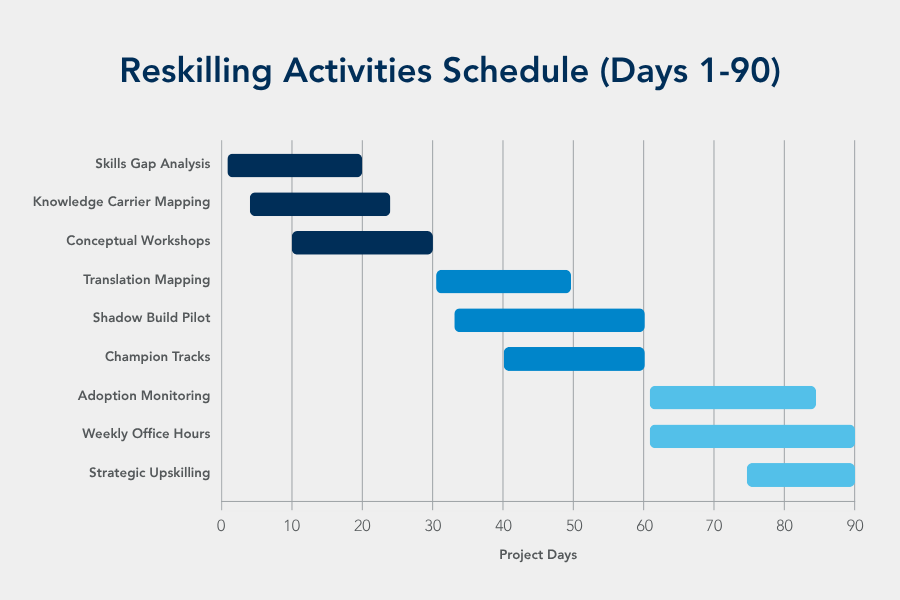
Phase 1: Foundation & Baseline (Days 1–30)
Focus: Assessing the landscape and establishing the conceptual shift.
- Skills Gap Analysis: Role-specific assessments to evaluate technical readiness for the destination platform.
- Institutional Knowledge Carrier Mapping: Inventorying critical institutional knowledge holders and involving them in early strategy.
- Conceptual Shift Workshops: Teaching “mental models”—how the destination platform thinks compared to legacy tools.
Phase 2: Translation & Hands-On (Days 31–60)
Focus: Active translation of workflows and parallel shadow builds.
- Translation Mapping: Building a cross-platform Rosetta Stone for legacy workarounds and custom logic.
- Shadow Build Execution: Recreating high-complexity campaigns in the new environment while the old one remains live.
- Champion Tracks: Providing advanced, early-access training for super-users to drive internal adoption.
Phase 3: Adoption & Optimization (Days 61–90+)
Focus: Continuous support, measurement, and future-readiness upskilling.
- Adoption Health Metrics: Tracking time-to-first-campaign and error rates across the team.
- Weekly Office Hours: Dedicated time for practitioners to troubleshoot complex builds and share best practices.
- Strategic Upskilling: Shifting MOps practitioners from execution-only to AI-ready, strategic optimization roles.
Understanding the MAP/CEP Migration as a Talent Development Moment
With a solid plan in place, a platform migration serves as a natural “reset button” for a Marketing Operations (MOps) team. It provides a rare opportunity to move practitioners away from tactical campaign execution toward strategic architecture. In legacy systems, MOps teams often spend the majority of their time navigating technical debt or creating and maintaining manual workarounds. By automating these processes in a new, modern MAP/CEP, leadership can redeploy that reclaimed time into higher-value activities like data orchestration, attribution modeling, and customer journey mapping. This transition allows your team to see themselves not just as “platform operators” but as strategic partners who are partners in designing the technical infrastructure that helps your organization to achieve broader business outcomes.
Furthermore, a migration is the ideal window to introduce AI-ready competencies, as modern platforms standardly provide native predictive capabilities and generative tools that require a new set of skills. Upskilling should focus on development topics such as moving the team from manual segment creation to supervising AI-driven audience discovery or graduating from basic A/B testing to managing autonomous experimentation. Training practitioners in prompt engineering, model oversight, and advanced data literacy ensures they are prepared to act as “AI orchestrators” within the marketing ecosystem. This shift not only protects the organization from process stagnation but also significantly increases the professional engagement of the team. It can mean the difference between a potentially stressful technical shift and a high-impact career development milestone.
Measuring Team Readiness and Adoption: The Metrics that Matter
Just as important as planning your migration and developing your plan for upskilling is being able to measure your team’s readiness and adoption health during a MAP/CEP migration. This requires a combination of both technical proficiency and sentiment-based metrics. Key readiness indicators include items such as training completion rates and successful shadow builds. These factors can be easily calculated on a pass/fail grading scale. However, the most telling metric to watch is time-to-first-campaign in the new environment compared to legacy baselines. If a team is taking significantly longer to launch a standard campaign in the destination platform than they did in the old one, it’s a clear signal that the “muscle memory” hasn’t yet transitioned and further operational reskilling is required. Additionally, tracking error rates and support ticket volume (or requests submitted to your internal mentors for assistance) during the first 90 days provides a direct pulse on team confidence. A high volume of “how-to” or configuration-based tickets suggests that the team may be technically trained but operationally overwhelmed.
Post-migration health can also be measured by feature utilization trends, specifically whether the team is adopting the advanced capabilities of the new platform or simply recreating legacy processes. If a team is only using 20% of a modern platform’s features, effectively treating it like the tool they just left, the migration has failed its strategic objective of driving innovation. To combat this, organizations should monitor team engagement and individual member retention, as a “brain drain” post-migration is a lagging indicator of a team that felt unsupported during the shift. Ultimately, measuring the shift in resource allocation from manual, execution-heavy tasks to more strategic, AI-driven optimization is a key indicator that your migration has successfully upskilled the team into higher-value, more rewarding roles.
Ultimately, a successful MAP/CEP migration reaches far beyond the technical cutover of assets and data. It is fundamentally a human capital transformation. By implementing a structured 90-day reskilling roadmap that prioritizes operational proficiency over basic platform mechanics, organizations can safeguard their institutional knowledge carriers and prevent post-migration stagnation. When executed with a focus on role-based gap analysis and strategic upskilling, a migration ceases to be a tactical hurdle and instead becomes a powerful catalyst for organizational change and professional growth where your Marketing Operations team transforms into strategic influencers ready to orchestrate AI-driven, high-value outcomes in their new digital home.

Share This
About the Author: Emily Eubanks