

What is BIMI?
BIMI, which stands for Brand Indicators for Message Identification, is an emerging email specification that allows businesses to display their brand logo directly in the recipient’s email inbox, right alongside the sender’s name and subject line. It works in conjunction with robust email authentication protocols like SPF (Sender Policy Framework), DKIM (DomainKeys Identified Mail), and, critically, DMARC (Domain-based Message Authentication, Reporting, and Conformance), ensuring that only legitimately authenticated emails can display the logo. By providing a standardized way for brands to present a verified visual identity in the inbox, BIMI aims to enhance brand visibility, build trust with recipients, and help users quickly identify genuine communications, thereby reducing the risk of falling victim to phishing and spoofing attacks.
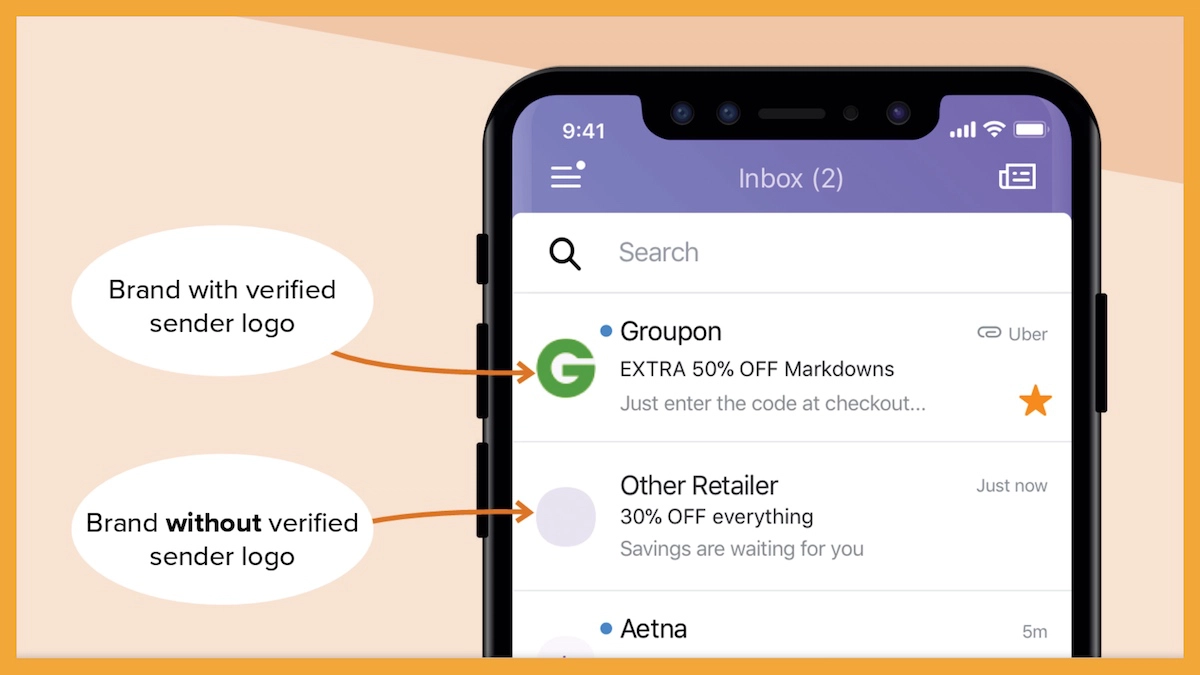
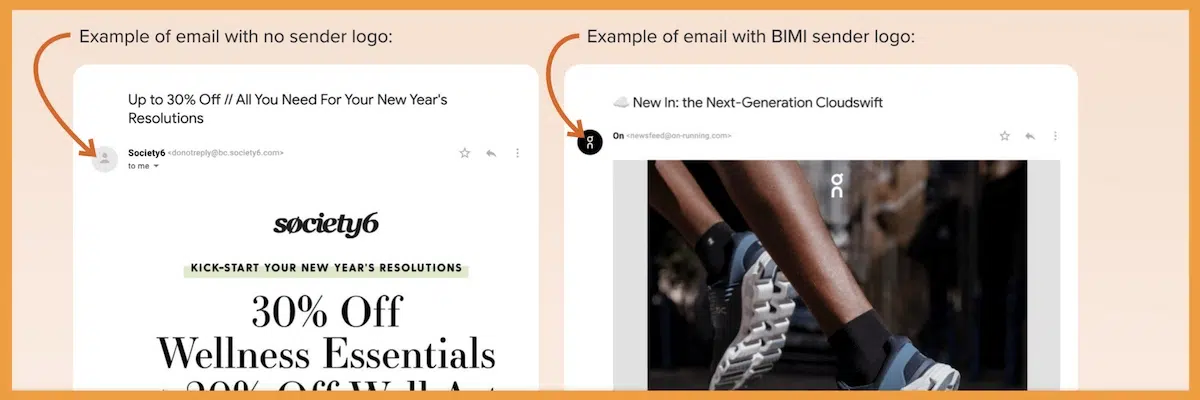
Source: https://www.litmus.com/blog/what-is-bimi-and-why-should-email-marketers-care
BIMI distinguishes itself from traditional email authentication protocols like SPF, DKIM, and DMARC by adding a visual layer to the verification process. While SPF confirms that an email originates from an authorized IP address for a domain, and DKIM uses cryptographic signatures to verify that the message hasn’t been tampered with in transit, these checks happen “behind the scenes” at the server level, invisible to the end recipient. DMARC then builds upon SPF and DKIM, providing instructions to receiving mail servers on how to handle emails that fail these checks. These traditional methods are purely about technical validation and security.
BIMI, however, leverages the established security of these protocols to provide a clear, user-facing indicator of authenticity. It doesn’t replace SPF, DKIM, or DMARC; rather, it requires their successful implementation, particularly a DMARC policy set to the enforcement level of quarantine or reject. This means that for a brand logo to appear in the inbox, the email must first pass these rigorous technical authentication checks. Once DMARC is properly configured and enforced, the BIMI record in the sender’s DNS then points to a verified version of their brand logo, often secured by a Verified Mark Certificate (VMC). In this way, BIMI acts as the visible output of a well-secured email sending infrastructure, turning abstract technical verification into an immediate, recognizable trust signal for the recipient.
Why is BIMI Important?
BIMI addresses a challenge in today’s digital communication: trust and visibility in a crowded and often malicious email environment. With the proliferation of phishing scams and brand impersonation, recipients are inherently wary of emails. Traditional email authentication (SPF, DKIM, DMARC) works diligently behind the scenes to verify a sender’s legitimacy, but it doesn’t offer a direct, visible signal to the user. BIMI fills this gap by presenting a verified brand logo directly in the inbox, acting as an immediate visual assurance that the email is truly from the expected sender. This immediate recognition combats inbox fatigue, helps legitimate emails stand out, and builds a crucial layer of confidence before the email is even opened.
For marketers, embracing BIMI is no longer just a “nice to have,” but an increasingly important strategic consideration. In a world where attention is scarce, the ability to display a trusted brand logo directly in the inbox provides a powerful competitive advantage. It fosters instant brand recognition, making your emails more memorable and easier to identify. Moreover, the enhanced trust and perceived legitimacy from BIMI can lead to higher open rates and increased engagement, directly impacting key marketing KPIs. By implementing BIMI, marketers not only strengthen their brand’s reputation and protect against costly phishing attacks, but they also proactively adapt to evolving email standards, ensuring their messages cut through the noise and resonate with an increasingly discerning audience.
How does BIMI Work?
BIMI doesn’t operate in a vacuum; it’s built upon the foundation of existing email authentication protocols. Think of SPF, DKIM, and DMARC as the security guards at the door, ensuring that only authorized senders enter. BIMI, then, is like the official uniform or badge worn by the authorized individual, making their identity immediately clear and verifiable. For BIMI to function correctly, a robust DMARC policy must be in place and actively enforced.
Let’s briefly revisit these foundational protocols:
- SPF (Sender Policy Framework): SPF allows domain owners to publish a list of authorized mail servers that are permitted to send email on behalf of their domain. When an email is received, the recipient’s mail server checks the SPF record to verify if the sending IP address is on the authorized list. If not, the email may be flagged as suspicious or rejected.
- DKIM (DomainKeys Identified Mail): DKIM adds a digital signature to outgoing emails, allowing the recipient’s mail server to verify that the email hasn’t been tampered with in transit and that it genuinely originated from the claimed domain. This signature is generated using a private key by the sender and verified using a public key published in the sender’s DNS records.
- DMARC (Domain-based Message Authentication, Reporting, and Conformance): DMARC acts as an overarching policy layer that builds upon SPF and DKIM. It allows domain owners to specify how receiving mail servers should handle emails that fail SPF or DKIM checks. DMARC also provides reporting capabilities, giving domain owners visibility into who is sending email on their behalf and whether those emails are passing authentication checks. A crucial element for BIMI adoption is that your DMARC policy must be set to “quarantine” or “reject” mode, meaning that emails failing authentication are either quarantined or outright rejected, not just monitored. This strong enforcement signals to email providers that your domain is actively protecting against spoofing, a prerequisite for displaying your brand logo.
How is BIMI Configured?
Implementing BIMI as a marketer involves a series of technical steps, but it’s a process that can be strategically managed to elevate your brand’s presence in the inbox. First and foremost, you must ensure your email authentication foundation is rock-solid. This means having SPF, DKIM, and DMARC configured correctly. This ensures that your domain is actively preventing email impersonation, a prerequisite for BIMI adoption. If your DMARC is currently set to p=none (monitoring), you’ll need to work with your IT or email deliverability team to analyze DMARC reports, identify legitimate sending sources, and gradually move towards an enforced policy without disrupting valid email streams.
Once your DMARC policy is securely enforced, the next step involves preparing your brand logo. The logo must be in a specific format: SVG Tiny 1.2, a highly secure and scalable vector graphic format. It’s recommended that your logo is square, clear, and doesn’t contain excessive text or complex details, as it will be displayed in a small, often rounded, space within the inbox. This SVG file needs to be hosted on a secure web server (HTTPS) with a stable URL. It is highly recommended to obtain a Verified Mark Certificate (VMC) from an authorized Certificate Authority (CA) such as DigiCert or Entrust. A VMC cryptographically binds your trademarked logo to your domain, providing an additional layer of trust and ensuring that email providers display your logo consistently. The VMC process involves a rigorous verification of your brand’s ownership of the logo and domain.
Finally, with your DMARC enforced, your SVG logo prepared and hosted, and your VMC acquired (if preferref), you will publish a BIMI TXT record in your domain’s DNS. This record typically includes the BIMI version (v=BIMI1), the URL where your SVG logo is hosted (l=), and the URL where your VMC file is hosted (a=). This DNS record tells supporting email clients where to find and verify your brand’s logo. After publishing, it’s crucial to use BIMI testing tools (often available from the BIMI Group or DMARC service providers) to ensure your implementation is correct and that your logo is displayed as expected across various email clients. While this process requires technical coordination, the visual branding, enhanced trust, and improved engagement that BIMI offers make it a worthwhile investment for any brand marketer.
A complete BIMI record in the DNS looks like this:
| Record Type | Name | Value | TTL |
| TXT | default._bimi | v=BIMI1; l=https://yourserver.com/logo.svg;a=https://yourserver.com/vmc.pem | Default |
Source: https://www.dmarcly.com/blog/what-is-bimi-bimi-explained
What is the Future of BIMI?
BIMI represents a significant step forward in the evolution of email marketing and communication. It moves beyond the limitations of text-based identification and introduces a powerful visual element that resonates with users on a deeper level. As email continues to be a cornerstone of digital communication, standards like BIMI will become increasingly vital for brands to maintain trust, enhance visibility, and stand out in an ever-evolving digital landscape.
While the initial implementation of BIMI requires technical diligence, the long-term benefits in terms of brand recognition, trust, and deliverability are undeniable. For forward-thinking brands committed to securing their communications and strengthening their bond with their audience, embracing BIMI isn’t just an option – it’s a strategic imperative for the future of email. By demystifying its workings and understanding its profound impact, businesses can leverage BIMI to transform their email presence from a mere communication channel into a powerful tool for brand building and customer loyalty.
If you are interested in enhancing your deliverability, give Relationship One a call. We are here to help.
Share This
About the Author: Melissa Santos