

Type in “The Future of Marketing Automation” into any search engine, and you’ll get the same five themes returned time and time again. The giant crystal ball in the sky predicts that marketers will see greater use of artificial intelligence (AI) across all marketing functions, continued growth of omnichannel or multichannel marketing efforts, widespread use of predictive analytics to support data-driven decision making, the critical importance of personalization, and an increased focus on enhancing data integration capabilities. These trends are already having a growing impact on B2B marketing automation platforms (MAPs).
In the B2B space, most, if not all, companies have a stable of tools in their marketing tech stack to automate their digital communications. There are the stalwart email marketing automation platforms like Adobe Marketo Engage, Oracle Eloqua, and Salesforce Marketing Cloud, and there are also platforms like Braze, Hubspot, and Klayvio that are now stretching beyond their B2C beginnings to become serious players in the B2B arena. Additionally, B2B organizations use a host of other channel tools such as website and content management systems, SEO ranking tools, individual social media platforms or social aggregators such as Sprinklr, Hootsuite, Zoho or Sprout, paid media channels, affiliate and/or influencer marketing, and so on. As marketers move toward that omnichannel campaign approach, the question arises: how can I do it all from just one platform?>
Omnichannel Orchestration with Ease
We are already seeing the trend toward employing Customer Data Platforms (CDPs) to aggregate all customer demographic and behavioral data in one place, map it with unified digital profiles for their contacts and prospects, quickly identify consumer trends, and apply predictive AI to hyper-target audiences for messaging. It is only a small leap for marketers to begin expecting their marketing automation system to allow activation of messaging in multiple channels all at once.
Multichannel marketing platforms like Adobe Experience Platform, Braze, and Salesforce Marketing Cloud, who are listed as leaders in Gartner’s Magic Quadrant for Multichannel Marketing Hubs, are quickly innovating to fill that gap to provide marketers a single platform to manage their primary digital marketing channels of email, mobile, in-app and push messaging. By activating multiple channels at the same time, marketers can spend their precious time constructing stellar campaigns instead of jumping between point-solution platforms to activate individual campaign channel tactics. Additionally, all of these channels are informed by AI to predict and target audiences with the right message via the right channels. Oh, and did I mention that campaign reporting is aggregated in these multichannel marketing automation platforms, too? Marketers can save even more time lost today with efforts to cobble together metrics from various tools into a comprehensive omnichannel campaign view.
According to Digital Commerce 360 in their August 2024 report on The State of B2B Omnichannel Best Practices, B2B buyers have nearly doubled the number of digital channels they use to evaluate and engage with sellers. In 2016, B2B buyers listed only four channels: email, in-person, telephone, and ecommerce site/login portal as their methods for making purchases for their company. Today, less than 10 years later, that list has grown to eleven, including mobile apps, e-procurement, live chats, and B2B marketplaces. Additionally, an increasing number of business buyer transactions are both beginning and ending online, highlighting the importance of offering a digitally driven, omnichannel experience for our customers.
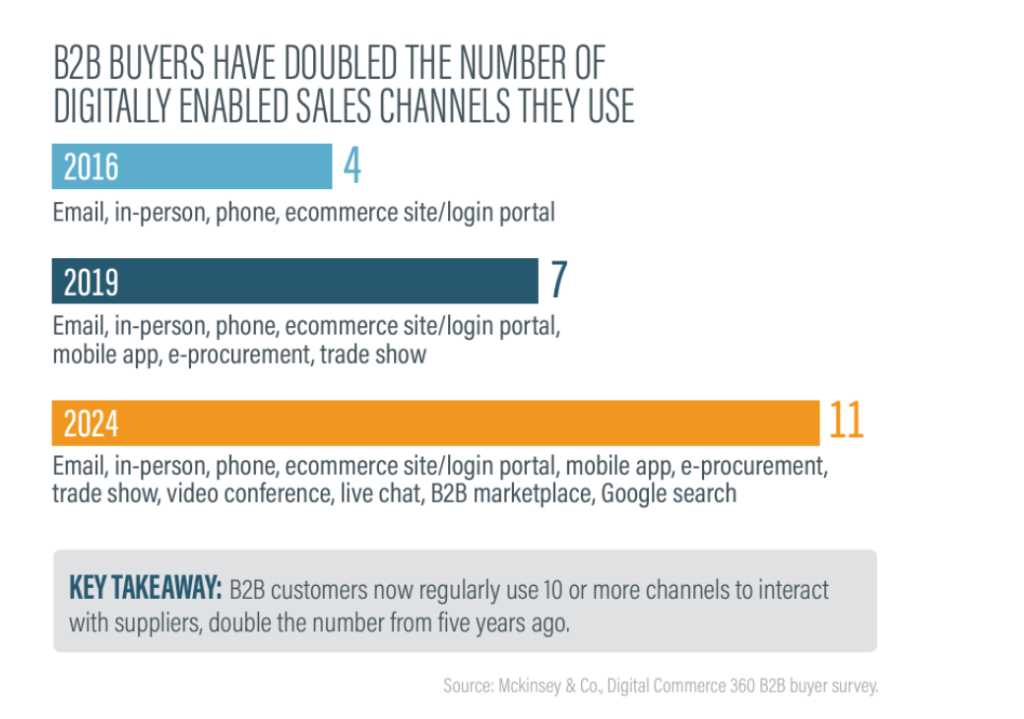
That means that our content must be visible and relevant on all the channels where our customers are evaluating and making purchase decisions. As our customers become more sophisticated and diverse in their methods of engaging with us, so must we. This is why easy multichannel or omnichannel orchestration will become one of the most important undertakings for marketers to tackle in the near future.
Are Traditional Marketing Automation Platforms Going Away?
The short answer? Absolutely not! MAPs will continue to have a place in the digital marketing ecosystem for the foreseeable future, but their role as the central hub of B2B marketing tech stacks that they have enjoyed for the past few decades will begin to shift. CDPs will move toward the central position, housing all demographic, behavioral, and purchase activity about an organization’s audience. With the aid of artificial intelligence (AI) and machine learning (ML), the CDP can quickly identify audiences that are ready for targeted messaging, match each contact with their preferred communication channel, and activate those audiences to the MAP for distribution. The orchestration, audience segmentation, and decisioning happens at the universal data layer where it can be triggered faster, cleaner, and more accurately. The MAP then becomes the digital content repository and the personalization and distribution engine of targeted messages delivered by the CDP.
We are also seeing the proliferation of many niche solutions that are tailored to specific industries and use cases. According to ChiefMartec’s most recent Marketing Technology Landscape report, we are seeing yet another year of growth in the number of marketing technology products in the space. There are 14,106 (and counting) products available, an addition of over 3,000 products since 2023 alone.

While traditional B2B marketing automation platforms like Adobe Marketo Engage, Oracle Eloqua, or Salesforce Marketing Cloud still continue to be widely used by businesses of all sizes, they may face pressures from newer competitors who are taking advantage of the changing marketing landscape with new channels, technologies, and customer behaviors. Niche solutions that can be more agile and responsive to developing trends can offer compelling solution alternatives to those businesses who have specific industry/functionality needs or significant resource constraints. But that doesn’t mean the “big dogs” are going away. For larger enterprises with complex marketing operations and integration requirements, the traditional marketing automation platforms will remain a vital part of the overall martech stack.
Is Personalization Still Important?
Personalization is still of great importance to your marketing efforts. In fact, it might even be more so. Our customers and clients expect that we know who they are, what their preferences are, and what they have purchased. In the recent Marigold’s Relationship Marketing Trends report, their survey results determined that 79% of respondents say that they are likely to engage with a personalized email tailored to their interests. Taking it a step further, they summarized it this way:
“The proof is in the numbers. Consumers want personalization. They want to be treated like individuals. They’re frustrated with one-size-fits-all marketing and are willing to reward brands who can transcend that antiquated form of marketing with their dollars.”
Nearly 70% of their survey respondents said that they would even pay more to shop with brands that have earned their loyalty by providing their customers with accurate, personalized experiences. Wow! That’s an astounding incentive for us to ramp up our personalization efforts for our customers!
What Does This Mean for Me?
What does all of this mean for marketers? In short, we all need to become data experts. We need to understand the data, where it’s coming from, and the segmentation/decisioning rules that identify audiences to send our targeted messaging. We need to understand how our companies collect, collate, and organize customer and prospect data so that we can ask the right questions of the data to deliver the right message to the right channel when buying signals indicate our audience is ready for that communication. And, we need to understand how the data all fits together to form that unified customer profile.
Marketers also need to be constantly learning. Change is happening fast in the marketing automation industry. Robust marketing automation is no longer a nice-to-have; it is a necessity, and is moving toward commoditization quite rapidly. Gone are the days where a marketer can work in one toolset all day long and envision themselves doing exactly the same job for the next 10 years. Tools are innovating, adding in generative AI and predictive analytics capabilities, and activating new, integrated channels at a break-neck pace in order to remain relevant and to keep up with the competition. Therefore, we must learn how to read the tea leaves so that we can align our skill sets to remain relevant as well.
Want to talk about the future? Need help figuring out your next step? Relationship One is here for you. Reach out to us today!

Share This
About the Author: Emily Eubanks